Dalia Milián Bernal and Ville-Pekka Säkkinen
We believe that when referring to identity in relationship to the built environment:
Identity is not universal.
Identity is full of meaning.
Identity is fluid, thus subject to change.
Identity is co-constructed, forming a feedback loop with the environment.
Most importantly, identity requires experience.
According to the Oxford English Dictionary, identity1 may refer “to the characteristics that determine what a person or thing is”, or the “similarity or affinity” of one thing with another. When referring to identity and the built environment, we believe there is no universal formula to follow, rather individuals confer places and spaces with meaning and identity through their personal experiences of them and the stories they tell about them.
In this essay, we explore how through our individual experience of a place we can unearth its identity, and in the process be influenced by it, transform it, and discover how it has shaped our own identities.
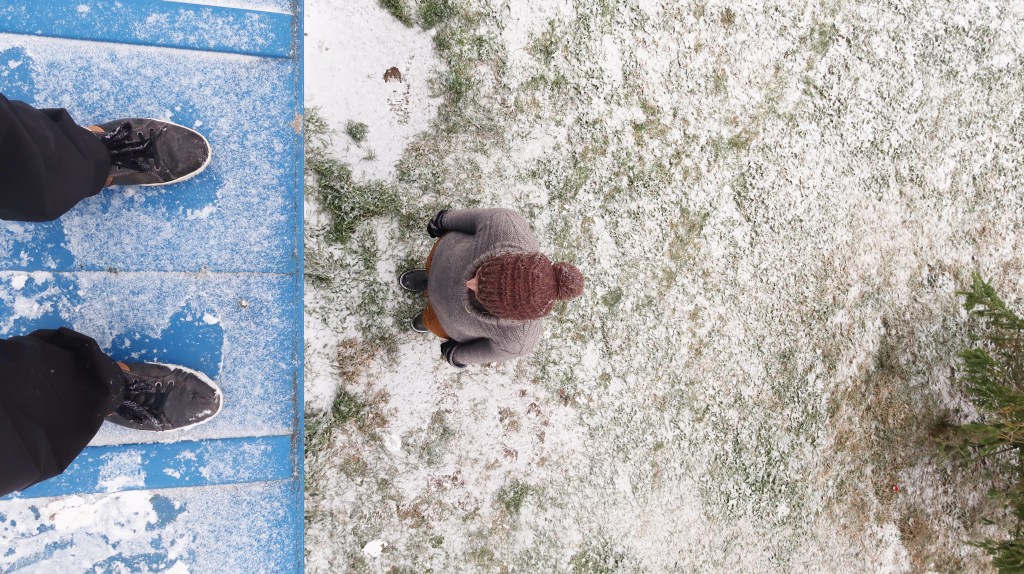
To understand this relationship, we did an experiential urban exploration in the city of Tampere, Finland. Each of us chose one site towards which we felt a certain affinity and visited the chosen places together (Figure 1). Through the images we produced of the locations and stories we wrote about them, we attempt to create a dialogue between our experience, the sites, and their identity – or lack thereof.
About the exploration

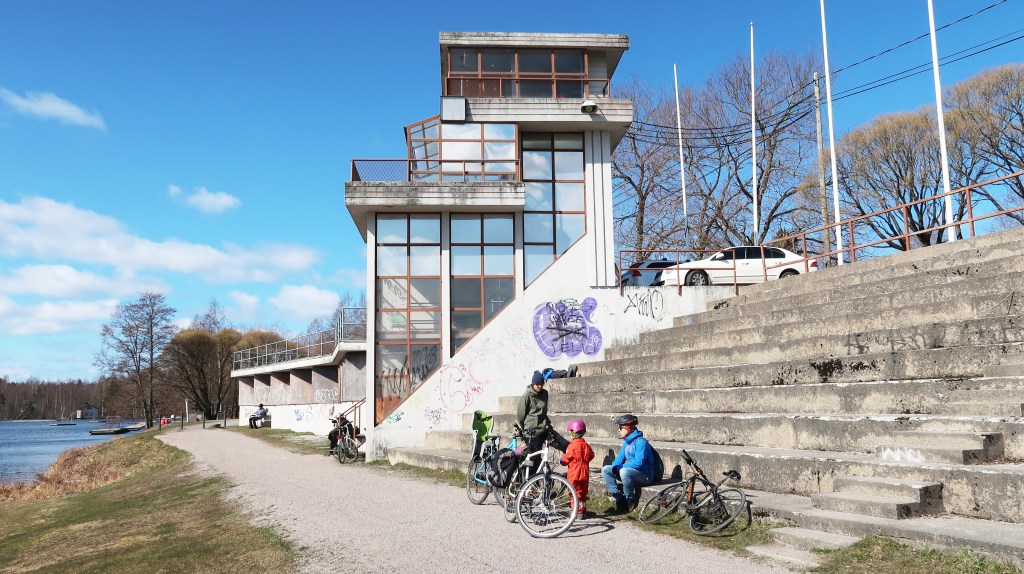
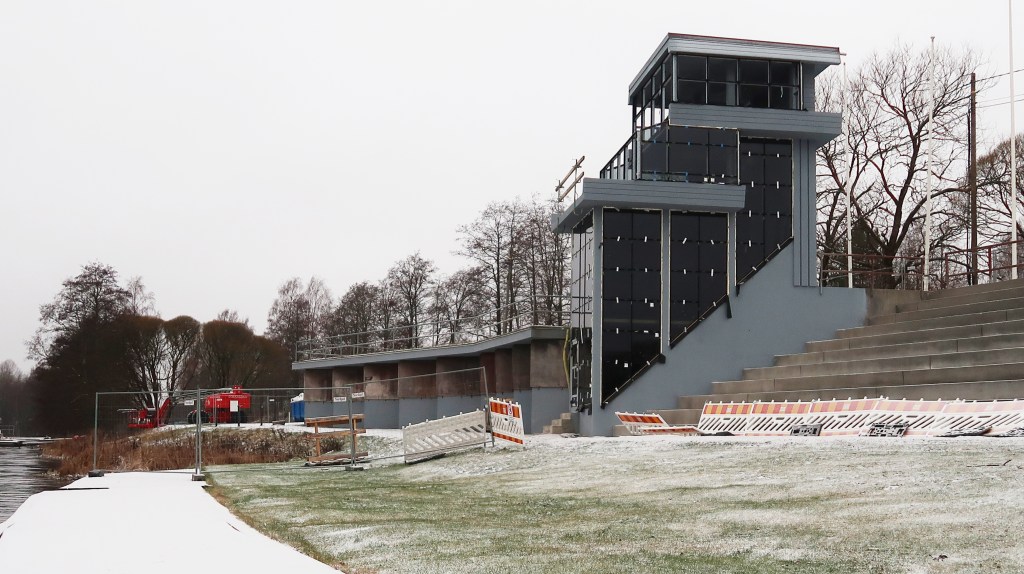
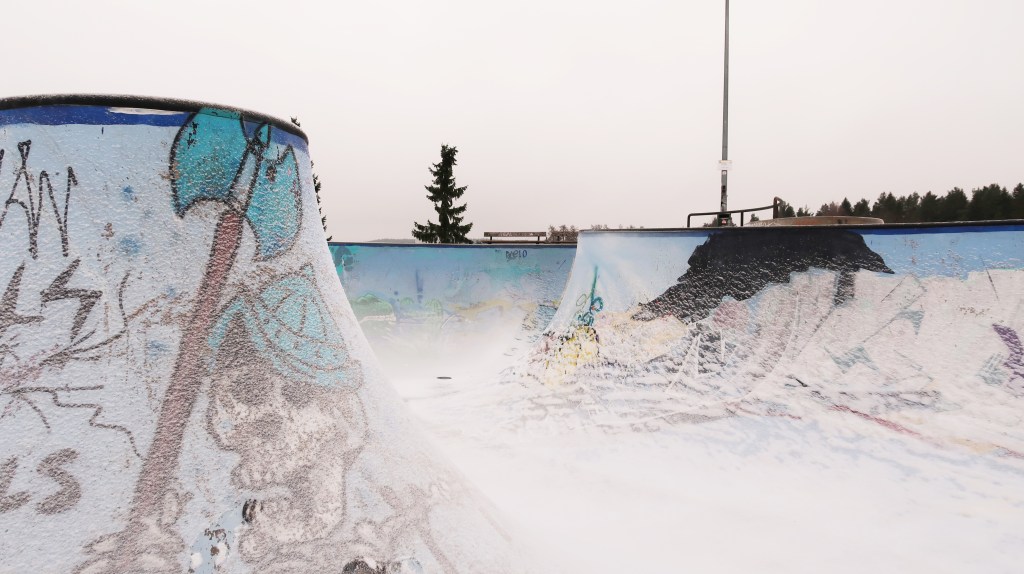
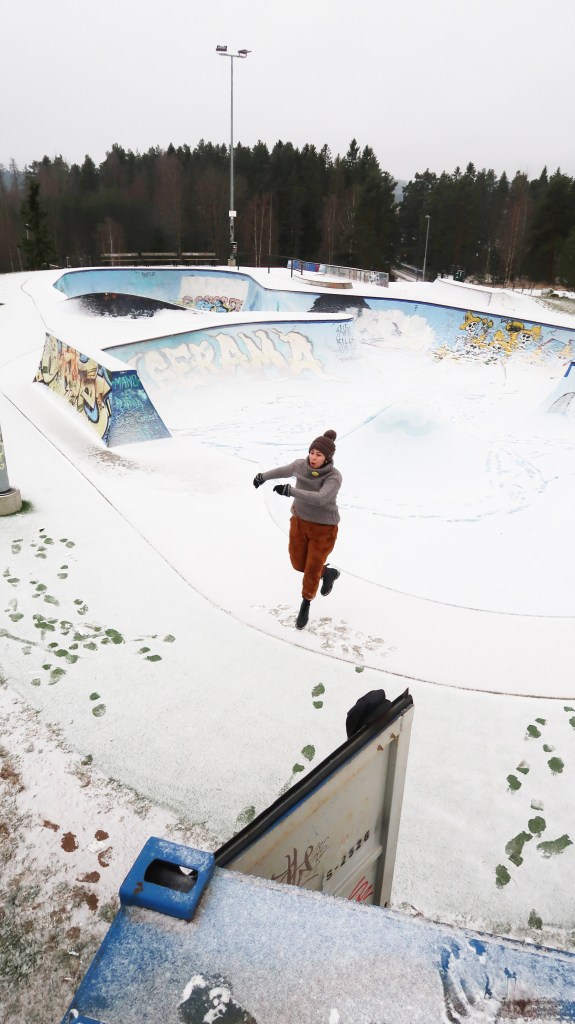
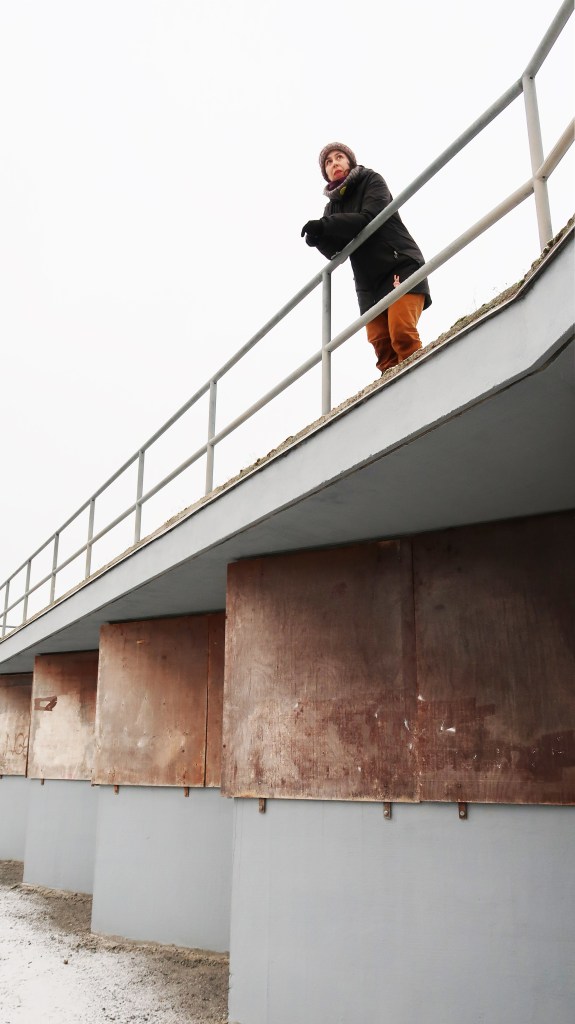
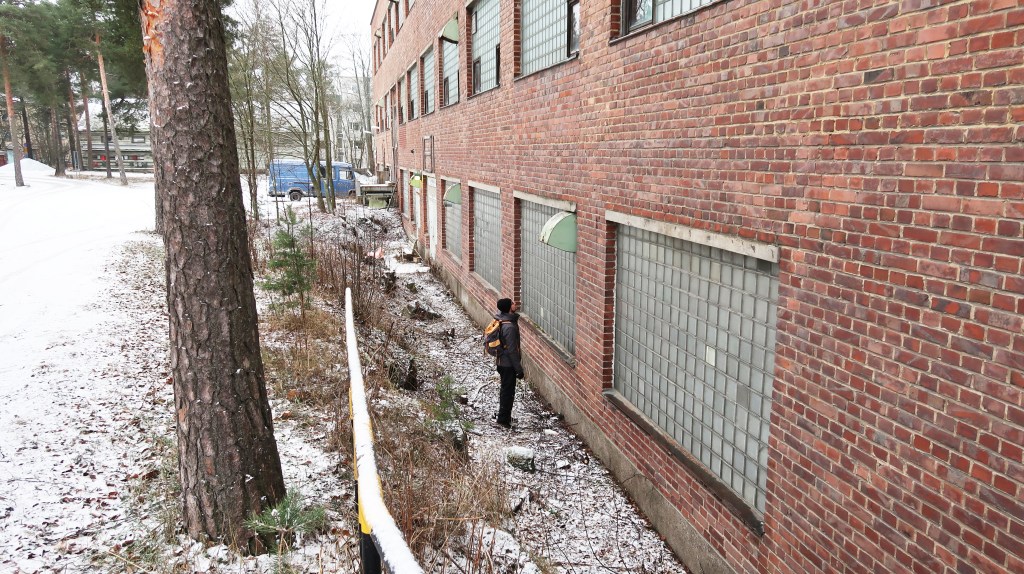
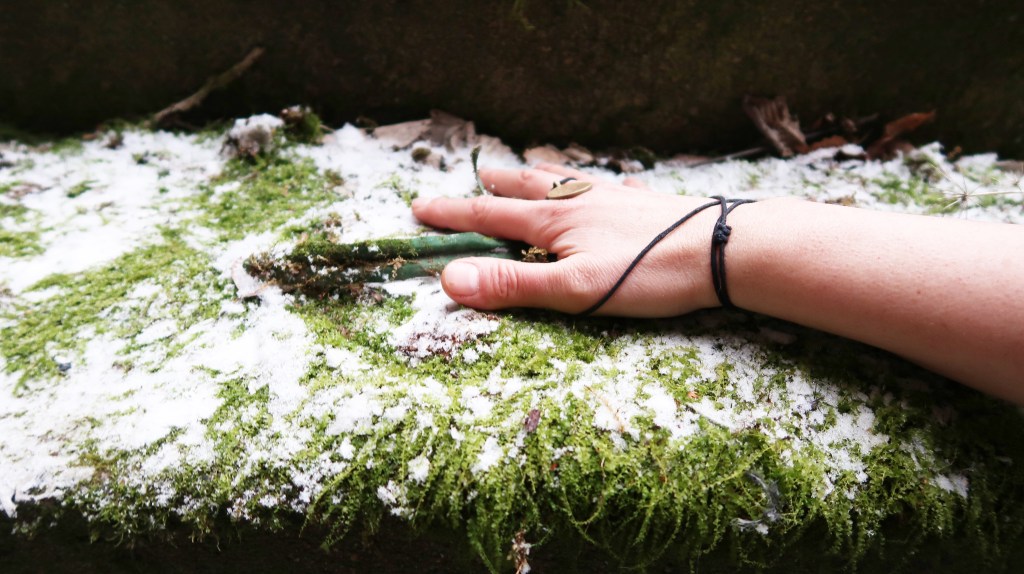
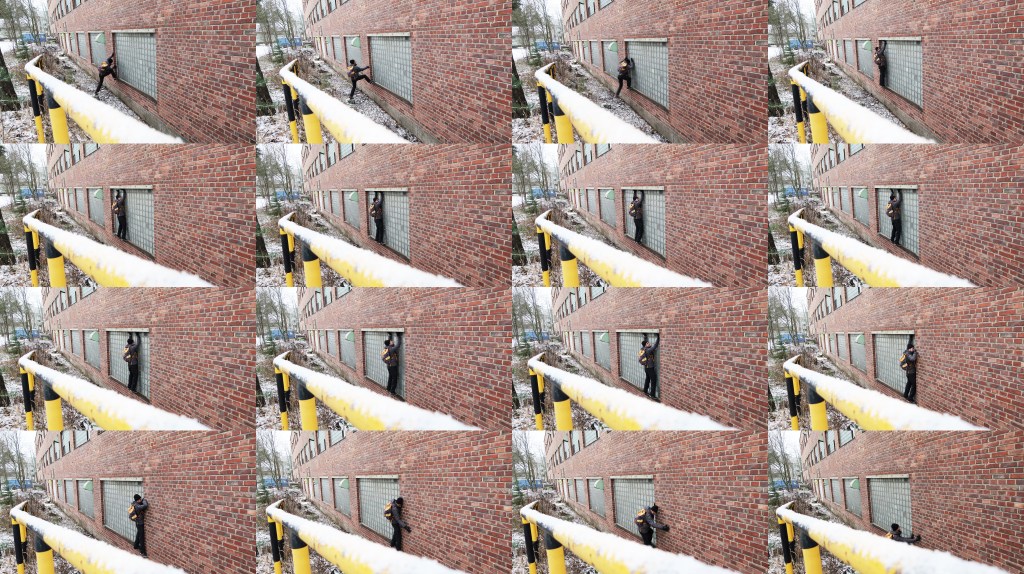
Each site we visited, planned or not, forms a section of this essay. A skateboarding bowl was our first site of interaction, located in Iso-Vilunen, a former gravel-pickup site transformed into a skateboarding park in 2015 (Figure 2).2 Subsequently, we explored an underused modernist construction possibly built in the 1960s. The construction is located on the shores of Kaukajävi lake. In the spring, the construction seemed to be abandoned (Figure 3), but at the time of our visit, the area was undergoing renovation (Figures 4). Our route to the next site was interrupted by an industrial building that used to house the Suomen Trikoo sock factory from 1903 to 2005.3 We played in its abandoned interstices, a liminal space between the built and the natural environment. Our journey ended on the shores of Onkiniemi, not far from the sock factory, in the cold waters of the Näsijärvi lake.
The Shuffling Machine
Ville-Pekka Säkkinen
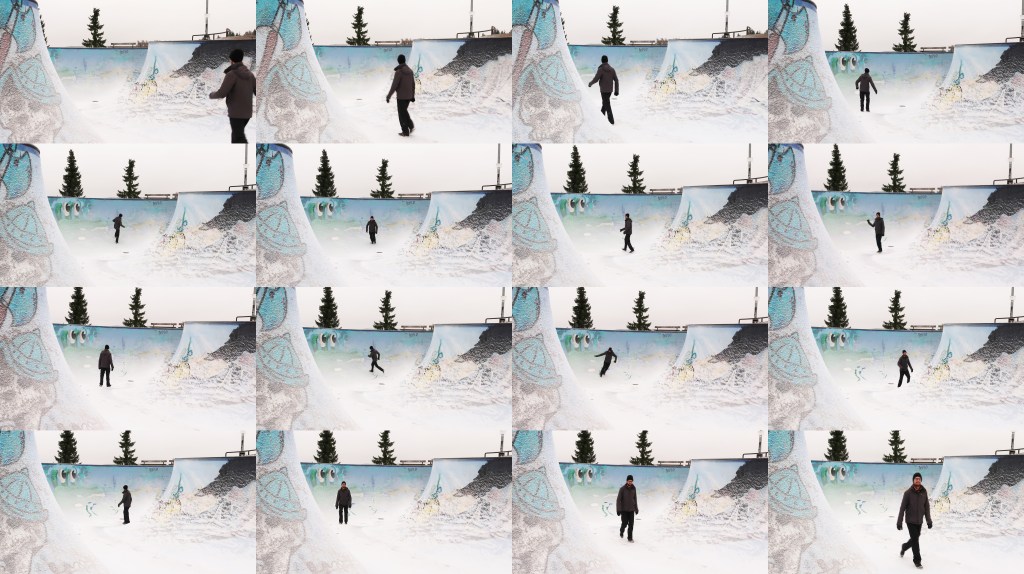
Swirling around in a bowl covered in snow,
like two runaway cogs spinning in this strange machine,
a peculiar merry-go-round at the top of the world.
Two dancers carve the powdery surface,
the lofty bends luring them with a promise of progress.
But this is a machine made of stone
its curves and bumps stand in silence, seemingly frozen in time.
Yet through the swirling, new paths are forged.
A new adventure around every turn, new stories unfolding,
others still out there to be found, unvisited and forgotten,
just around the next bend,
in this shuffling machine, cast in concrete
Lost Identity
Dalia Milián Bernal
Walls painted grey;
Graffiti erased.
Concrete grandstands plastered;
Time erased.
Windows like offices;
Identity lost.
It is a summer day in 1960s and a woman sits on the stands of a small, fine constellation of modernist architecture conformed by a little viewing tower, a rather modest concrete grandstand, and a platform elevated by an intricate zig-zagged wall. She is struck by the sun’s rays, enjoying the warmth that is captured and released, looking at the boats that move at the pace of the propelling oars. There is a lot of sound in the background, like the sound of people cheering or splashing into the water or talking while they walk by. The sounds, the people, the place make her feel part of something.
Fast-forward, the tower is closed and its walls have become a public canvas for graffiti, elevating the charm of this place. But, on a grey winter day in 2020, without the warmth of the sun or the sound of the water or the murmurs of passers-by, the color of the graffiti has been erased and the little tower is being glazed with black glass – as if to conceal a secret.
Like most modern architecture, this small modernist constellation could be anywhere in the world. And, like much of modern architecture, it is being destroyed, not by demolition, but by erasing the era in which it was constructed and with it, the passing of time and the stories of people.
This little tower need not be in Finland, nor does it represent any sort of Finnishness, whatever that should be. I don’t believe that the built environment can represent a collective national identity. But maybe I deny the idea of national identity altogether as it evokes images of fascist architecture in Europe; it also contradicts the fact that in Finland I feel at home – even though I was born and raised in Mexico. Maybe it is exactly that fact that makes this constellation so appealing to me: it represents a universality, not a generic one, rather one that connects it to the world, that makes it part of something.
It was the modesty and subtlety of this small modernist architectural assemblage, neglected but not abandoned, universal and local at once, intricate yet not pretentious, that made it so aesthetic and attracted me to it. I think its derelict appearance gave me a sense that it does not belong to anyone and, therefore, it belongs to all of us. That is the identity I believe we should seek in architecture, one that conveys a sense that we can be part of it and that we can transform it through the marks left by our experiences. I wonder if that sense will change in this little modernist space. Only time will tell – that is if the marks of time are not erased once again.
The sock factory
Dalia Milián Bernal
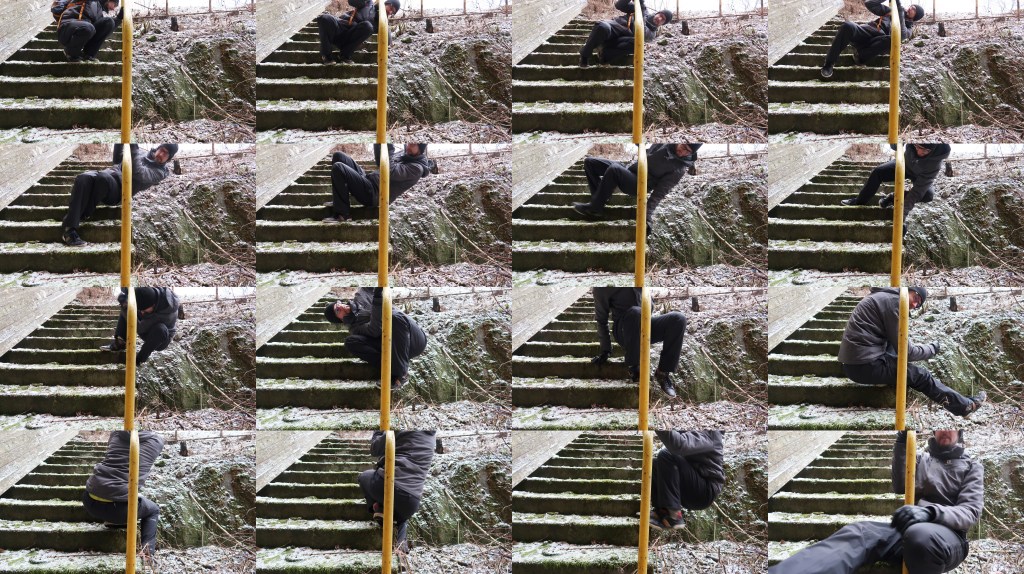
While we explore this partially abandoned industrial building (Figure 9), I remember Solà-Morales’ essay Terrain Vague.4 I think of the role of photography in creating a carefully curated image of the city; I think of the concept of terrain vague, an urban space that is empty and unoccupied on the one hand, and free, available and unengaged, on the other.5 We find a set of stairs. On them grows moss that looks like a natural carpet (Figure 10). The unoccupied stairs, unengaged for a long time, have become free and available for other forms of life to grow on them and became our urban playground.
Uncharted waters
Ville-Pekka Säkkinen
There is a rugged beach by the edge of the city and, at the end of it, a set of concrete stairs descending into the icy waters. There used to be industry in here, forming the backbone of a city that grew between two lakes. Once occupied by a range of piers, warehouses and shacks, the surrounding hillside has slowly succumbed to the expansion of a new urban form as construction and landscape beautification efforts have continued to chip away the past. Yet some parts of the shore have reimained the same, partly protected by the sketchy form of the land. A few worn brick buildings still remain as remnants of a bygone era and small bits of untampered vegetation stand their ground against the pressures of urban progress.
This place forms a strange socio-ecological niche. In this transitional space a new cultural flora emerges mirroring the change from the urban realm into the natural world. The place attracts various inhabitants, some visible by their presence and others witnessed only by the marks they leave. There is an odd assortment of worn-out furniture and the remains of a campfire situated by the bank of the lake, seemingly unused, but shifting ever so slightly every now and then. In the summer, a flock of gulls nests between the rocks and their offspring meander around the beach clearly undisturbed by the presence of people. Strangely enough, every summer, a man in a swimsuit with a video camera is witnessed recording the first steps of these small creatures. Then there are the odd bunch of passers-by. Some of them are the people who stand on the edge of the concrete steps that lead into the water.
I can’t speak for the other people going in there. This place attracts strange folk who may explain their actions by citing how it benefits their health and increases productivity. For me those kinds of reasons are of little value. I forget the noise of the nearby highway as I step on the stone cold steps and slip, almost smashing my head on the solid concrete. As I continue venturing into the murky depths, I know where the steps are taking me; they lead beyond the edge of progress.

- Identity. (2020). In Lexico-Oxford Online Dictionary. Retrieved from https://www.lexico.com/en/definition/identity ↩︎
- See City of Tampere. (2020). Iso-Vilusen skeitti-, BMX- ja trial-pyöräilypuisto
Retrieved from https://www.tampere.fi/kulttuuri-ja-vapaa-aika/liikunta/liikuntapaikat/iso-vilusen-skeitti-bmx-ja-trial-pyorailypuisto.html ↩︎ - Suomen Trikoo. (2020, March 30). In Wikipedia. https://fi.wikipedia.org/wiki/Suomen_Trikoo ↩︎
- Sola-Morales, Ignasi de. 1995. “Terrain Vague.” In Territorios, 123–32.
Barcelona: Gustavo Gili. ↩︎ - Ibid., 126. ↩︎
 dalia milián bernal